.jpg)
A fire pit that performs well in a private backyard is not automatically appropriate for a restaurant, hotel, condominium, apartment community, rooftop lounge, golf course, resort, or other shared commercial space. These projects introduce additional requirements involving safety certification, ignition controls, gas capacity, guest circulation, weather exposure, maintenance, service access, and long-term property management.
The enclosure is only one part of the system. Contractors and specifiers must also evaluate the burner, ignition option, fuel configuration, controls, listed input, electrical requirements, installation manual, and commercial warranty terms. A durable concrete or steel enclosure does not automatically make every available configuration suitable for commercial use.
This SpotixPro guide helps contractors, developers, landscape professionals, architects, designers, business owners, and property managers compare gas fire pits for commercial environments. It also highlights complete fire pits and fire tables for restaurants, hotels, condominiums, rooftops, pool decks, clubhouses, golf courses, and shared outdoor amenities.
SpotixPro Quick Answer: Select a commercial fire pit based on the property type, expected group size, available space, desired flame presentation, fuel supply, total gas demand, ignition system, control strategy, product certification, enclosure material, wind exposure, drainage, guest circulation, maintenance access, and commercial warranty terms. Verify that the exact burner, fuel, input, and ignition configuration is approved for the intended installation before ordering.
Commercial Fire Pit Planning Checklist
Review the complete project before choosing a fire pit based only on appearance, dimensions, or listed BTUs.
- Identify the property type and expected users.
- Confirm whether the installation is residential, hospitality, commercial, institutional, rental, or public-facing.
- Determine whether the fire feature will be guest-operated, staff-operated, or controlled by the property.
- Estimate the typical and peak group size.
- Decide whether the feature is primarily decorative, a gathering point, or intended to provide localized warmth.
- Compare round, square, rectangular, and linear layouts.
- Confirm the overall enclosure dimensions.
- Confirm burner dimensions and total input.
- Select natural gas or propane.
- Verify gas-line, meter, tank, and regulator capacity.
- Select match-light, flame-sensing, or electronic ignition.
- Verify the exact certified or listed configuration.
- Confirm the available electrical voltage when electronic ignition is used.
- Choose the control method.
- Determine whether a timer or automatic shutoff is required.
- Review emergency-stop or access-control requirements.
- Identify the control, transformer, valve, and ignition-module locations.
- Review seating distance and guest circulation.
- Account for servers, carts, movable furniture, and accessible routes.
- Confirm combustible clearances and overhead conditions.
- Evaluate wind exposure and building-induced turbulence.
- Plan burner-pan, enclosure, and surrounding-site drainage.
- Review pool splash, irrigation, rain, snow, freeze-thaw, salt air, and other exposure.
- Determine whether a glass wind guard is appropriate.
- Select approved fire media and calculate the required quantity.
- Preserve access to the burner, pan, valve, controls, gas connection, and electrical components.
- Confirm commercial warranty coverage and replacement-part availability.
- Create a cleaning, inspection, and seasonal shutdown plan.
- Plan staff training, operating instructions, and emergency signage.
What Makes a Fire Pit Suitable for Commercial Use?
The term “commercial fire pit” can describe several different situations. Some products are offered with burner and ignition configurations specifically intended for commercial or shared-use installations. Other complete fire pits may be considered for a commercial project only when the manufacturer approves the exact application and configuration.
A commercial-ready fire feature should be evaluated for:
- Manufacturer approval for the property type
- Certification or listing for the exact ignition configuration
- Commercial-use warranty coverage
- Stainless-steel burner and internal components
- Flame-sensing or electronic safety controls when required
- Timer, key-switch, wall-switch, or emergency-stop compatibility
- Durable enclosure construction
- Proper burner-pan drainage
- Wind and environmental performance
- Accessible valves, controls, transformers, and ignition components
- Replaceable burner and control components
- Appropriate heat output and flame distribution
- Clear operating instructions
- Long-term replacement-part support
Commercial-Use Warning: The enclosure material alone does not determine whether a fire pit is suitable for a commercial property. The burner, ignition system, fuel configuration, controls, installation, certification, and warranty must also match the project.
Verify the Exact Certified Configuration
Many fire pits are offered with several ignition choices. Certification or commercial-use approval may apply only to specific versions. Never assume that every ignition or fuel option displayed on a product page carries the same approval.
Before ordering, confirm:
- Exact product and burner model numbers
- Match-light, flame-sensing, or electronic ignition
- Natural gas or propane
- Listed input rating
- Required operating pressure
- Required electrical voltage
- Approved transformer and control components
- Installation-manual revision
- Commercial-use warranty language
- Required timer, switch, emergency stop, or access control
- Whether field modifications affect the listing
- Whether local authorities require additional documentation
Keep the product manual, certification documents, approved configuration, model information, and commissioning records with the project file.
Complete Fire Pit or Custom Fire Feature?
Commercial projects can use a complete manufactured fire pit or a custom enclosure built around a burner system. Each approach creates different responsibilities for the contractor and design team.
| Fire-Feature Type | Best Application | Advantages | Main Planning Requirement |
|---|---|---|---|
| Complete Fire Pit | Hotels, restaurants, clubs, and amenity patios needing a coordinated product | Enclosure, burner, and available finishes are designed as one package | Verify the exact ignition, fuel, certification, and warranty configuration |
| Fire Table | Restaurant lounges, hotel terraces, and conversational seating | Provides a perimeter surface around the flame area | Protect drinks, furniture, and belongings from heat and displaced media |
| Fire Bowl | Entries, pool decks, accent zones, and smaller gathering areas | Strong visual impact with a compact footprint | May offer less usable perimeter surface than a table |
| Linear Fire Pit | Rooftops, seating walls, modern patios, and long lounge arrangements | Supports long sightlines and conversational seating | Coordinate burner coverage, wind, furniture length, and gas demand |
| Ready-to-Finish Enclosure | Architectural projects requiring a custom exterior finish | Allows the fire feature to match masonry, tile, or other project materials | Final durability and access depend on field installation |
| Custom Burner System | Fully custom commercial landscapes and architectural installations | Maximum flexibility in shape, length, finish, and controls | Requires detailed coordination of enclosure, ventilation, drainage, clearances, and listing requirements |
How to Select the Right Fire Pit Size and Shape
Fire pit dimensions should be selected around the occupied space, not an empty patio plan. Furniture, servers, carts, planters, pathways, and guest movement all reduce the usable area after the property opens.
Round Fire Pits
Round fire pits work well as central conversation features because seating can wrap around the enclosure. They are useful for clubhouses, golf courses, condominium patios, and hotel courtyards where guests gather in a circle.
Square Fire Pits
Square fire pits complement symmetrical furniture arrangements and compact seating groups. Their corners should be considered when laying out circulation and movable chairs.
Rectangular Fire Pits
Rectangular fire pits pair naturally with sofas, benches, restaurant lounge furniture, and long conversational seating. They can support larger groups without requiring guests to gather around every side.
Linear Fire Pits
Linear features can define an outdoor room, emphasize architectural sightlines, or run parallel to long seating arrangements. They are especially useful on rooftop lounges, modern hotel terraces, luxury apartment amenities, and contemporary restaurant patios.
Multiple Smaller Features
Several compact fire pits can divide a large property into smaller gathering zones. This can reduce crowding and allow one area to remain available while another feature is being cleaned or serviced.
Planning Reminder: Larger does not always mean more usable. An oversized enclosure can consume valuable seating space, restrict circulation, or push guests too close to the flame.
Plan Heat Output Around Guest Comfort
Listed BTUs are only one part of fire-feature performance. Contractors should also evaluate burner size, flame distribution, enclosure height, media, wind, seating distance, and outdoor temperature.
Consider:
- Whether the feature is primarily decorative or expected to provide noticeable warmth
- Burner length or diameter
- Total input
- Flame height and distribution
- Distance from the burner to surrounding seating
- Enclosure height
- Wind exposure
- Fire media depth and type
- Nearby walls, roofs, umbrellas, and furnishings
- Whether separate patio heaters are needed
Open gas fire pits generally provide ambiance and localized radiant heat. They should not automatically be treated as a replacement for a complete commercial patio-heating plan.
Compare Ignition and Control Options
| Ignition Type | Best Application | Advantages | Commercial Consideration |
|---|---|---|---|
| Match Light | Supervised areas with a simple operating plan | Fewer electrical components | May not satisfy the required certification, control, or flame-safety strategy |
| Match Light with Flame Sensing | Commercial projects needing flame-loss protection without full electronic automation | Designed to stop gas flow if the flame is lost | Confirm certification, lighting procedure, reset process, and control access |
| Electronic Ignition | Hotels, restaurants, resorts, rooftops, and managed amenities | Supports controlled startup, flame monitoring, and automatic shutdown | Requires power, approved controls, drainage, accessible components, and maintenance |
| All-Weather Electronic Ignition | Exposed commercial spaces where environmental resilience is a priority | Designed for more demanding outdoor operating conditions | Still requires correct installation, drainage, power, inspection, and service access |
Commercial control strategies may include:
- Manual key valves
- Wall switches
- Key switches
- Countdown timers
- Staff-controlled switches
- Emergency-stop controls
- Access-controlled operation
- Building-management or automation integration
Plan Timers and Automatic Shutoffs
A commercial fire pit should not depend entirely on every guest remembering to shut off the feature. The control strategy should reflect how the property is staffed, supervised, and operated.
Consider:
- Countdown timers
- Restricted operating hours
- Staff-only controls
- Keyed access
- Emergency-stop placement
- Automatic shutdown after flame loss
- Reset procedures
- Clear operating labels
- Posted emergency instructions
- Integration with the property’s operating plan
Natural Gas or Propane?
| Fuel | Advantages | Commercial Considerations |
|---|---|---|
| Natural Gas | Continuous supply without routine cylinder replacement | Requires permanent piping, adequate meter capacity, correct pressure, and coordinated shutoffs |
| Bulk Propane | Useful where natural gas is unavailable | Requires tank placement, refill planning, regulators, security, and sufficient vaporization capacity |
| Portable Propane Cylinder | Can simplify limited or temporary applications | May be impractical or restricted in unattended shared spaces and requires secure cylinder management |
Confirm Gas-Line and Regulator Capacity
Large commercial fire pits and projects with several fire features can create substantial gas demand. Confirm the combined load before finalizing the burner size or ignition system.
Gas planning should account for:
- Total input of each fire pit
- Number of fire features
- Simultaneous operating demand
- Fuel type
- Available pressure
- Pipe diameter
- Run length
- Fittings and elevation changes
- Meter or propane-system capacity
- Regulator requirements
- Other connected grills, fireplaces, patio heaters, and appliances
- Individual shutoff-valve locations
An undersized gas system can cause low flames, unstable operation, delayed ignition, nuisance shutdowns, and poor performance when several appliances run at once.
Plan Placement, Seating, and Guest Circulation
Evaluate the completed, occupied patio rather than only the empty construction area. Movable furniture often shifts after opening, and restaurant or hotel operations may introduce service carts, trays, umbrellas, planters, or temporary event layouts.
Coordinate:
- Manufacturer clearances
- Seating distance
- Walking paths
- Server circulation
- Emergency egress
- Accessible routes
- Furniture movement
- Umbrellas and shade structures
- Planters and landscaping
- Railings and property boundaries
- Overhead roofs, pergolas, canopies, and balconies
- Guest contact with hot surfaces
- Control access
- Emergency-stop visibility
Layout Warning: Evaluate the fire pit with furniture in its real operating position. Chairs and tables may be moved closer to the flame after the property opens.
Should a Commercial Fire Pit Have a Glass Guard?
A glass wind guard can help create a visible and physical boundary around the burner. It may also reduce direct wind across the flame in some installations.
Consider a guard where:
- Guests sit close to the burner
- Drinks or small items may be placed on the table surface
- Wind affects flame stability
- Restaurant service occurs near the feature
- Children may be present
- Furniture surrounds the fire pit
- Fire media could be disturbed
A guard does not make every installation safe or eliminate clearance requirements. It can also affect radiant heat, airflow, cleaning, and access to the burner.
Plan for Wind, Rain, and Drainage
Commercial fire features are often installed in more exposed environments than residential units, including rooftops, pool decks, open courtyards, coastal hotels, and high-rise terraces.
Review:
- Prevailing wind
- Building corners and wind tunnels
- Rooftop turbulence
- Rain and roof runoff
- Pool splash
- Irrigation
- Burner-pan drainage
- Enclosure drainage
- Control-box and transformer locations
- Snow and ice
- Freeze-thaw conditions
- Protective covers
- Seasonal shutdown procedures
Drainage Warning: Water entering the burner pan or ignition enclosure can contribute to corrosion, delayed ignition, nuisance shutdowns, and service calls. Drainage is a functional requirement, not merely an enclosure detail.
Compare Fire Pit Enclosure Materials
| Material | Advantages | Commercial Considerations |
|---|---|---|
| Glass Fiber Reinforced or Lightweight Concrete | Substantial appearance with many colors and textures | Can stain, chip, weather, or develop natural surface variation |
| Powder-Coated Steel | Crisp forms and broad color flexibility | Coating damage should be addressed to limit corrosion |
| Stainless Steel | Modern appearance and corrosion resistance | Shows fingerprints, requires cleaning, and may discolor near heat |
| Corten or Weathering Steel | Distinctive architectural patina | Runoff and staining of nearby surfaces must be planned |
| Ready-to-Finish Construction | Can match the surrounding architecture | Final durability depends on field-applied materials, drainage, ventilation, and workmanship |
Concrete is not indestructible, and stainless steel is not corrosion proof. Every commercial enclosure requires routine cleaning and inspection.
Top Fire Pits for Commercial Spaces
The products below represent different shapes, sizes, materials, ignition choices, and project applications. Confirm the exact fuel, input, ignition, certification, and warranty configuration with SpotixPro before ordering for a commercial property.
| Best For | Product | Shape / Size | Material | Commercial Planning Note |
|---|---|---|---|---|
| Large Round Gathering Areas | The Outdoor Plus Unity | Round, 60 x 24 inches | Powder-Coated Steel | Verify the exact flame-sensing or electronic configuration required for commercial use |
| Large Rectangular Concrete Installations | Prism Hardscapes Tavola 8 | Rectangle, 60 x 32 inches | Concrete | Plan finish care, drainage, media, and model-specific ignition approval |
| Traditional Round Fire Table Layouts | Fire by Design Legacy Round | Round, 48 inches | Finish Varies by Configuration | Evaluate available electronic ignition and service access |
| Restaurant and Hospitality Seating | Outdoor GreatRoom Uptown | Multi-Level Rectangle, 48.25 x 64.5 inches | Mixed Architectural Materials | Coordinate guest use of the table surface, controls, and commercial warranty eligibility |
| Multiple Compact Gathering Zones | Prism Hardscapes Moderno 5 | Round, 36 inches | Concrete | Useful for repeated installations when utilities and maintenance are coordinated |
| Oversized Statement Features | The Outdoor Plus Coronado | Rectangle, 84 x 28 inches | Wood-Grain Finish | Coordinate gas demand, seating layout, certified configuration, and service access |
| High-Output Linear Concrete Features | HPC Fire Dekko Sonoma | Linear, 72 inches | Lightweight Concrete | Ignition selection can materially affect input, power, controls, and gas demand |
| Weather and Water Management | Warming Trends AON R60 | Rectangle, 60 inches | Concrete-Style Fire Table | Review WaterStop components, ignition selection, drainage, and electrical planning |
| Unique Modern Linear Design | The Outdoor Plus Baja Linear | Linear, Multiple Lengths | Black-and-White Powder-Coated Steel | Use its sculptural design and scalable lengths to coordinate modern architecture and furniture layouts |

Best Large Round Gathering Feature: Unity Gas Fire Pit
Best for: Hotel courtyards, golf courses, clubhouses, condominium patios, and large circular seating areas.
The Unity Gas Fire Pit by The Outdoor Plus creates a broad central focal point with a 60-inch diameter and a low, contemporary profile. Its round form works naturally with curved benches, lounge chairs, or seating arranged around the feature.
The powder-coated steel enclosure is available in multiple finishes, allowing designers to coordinate the fire pit with furniture, architectural accents, and the surrounding landscape. Its large burner and high input can support a prominent flame presentation, but contractors should verify gas capacity, seating distance, wind exposure, and the exact certified ignition configuration.
Before ordering, confirm:
- Fuel type
- Listed input
- Exact ignition option
- Commercial certification for the selected configuration
- Control and timer requirements
- Required power when electronic ignition is selected
- Drainage and protective-cover requirements
- Access to valves and ignition components

Best Large Rectangular Concrete Fire Pit: Tavola 8
Best for: Restaurant lounges, hotel terraces, resort patios, and large conversational furniture arrangements.
The Prism Hardscapes Tavola 8 uses a 60-by-32-inch rectangular layout that works well with sofas, benches, and long seating groups. Its concrete enclosure provides a substantial architectural appearance and is offered in multiple colors for coordination with the surrounding project.
The enclosure can suit demanding outdoor environments, but the project must still account for finish care, drainage, burner maintenance, fire-media placement, ignition certification, and commercial warranty terms. Concrete may show natural variation and should be protected from staining, impact, improper winter storage, and standing water.
Before ordering, confirm:
- Overall weight and placement requirements
- Fuel and input
- Available ignition options
- Certification for the selected configuration
- Required fire media
- Drainage
- Cover and seasonal-care recommendations
- Gas and control access

Best Traditional Round Fire Table: Legacy Round
Best for: Clubhouses, hotels, restaurants, and shared patios needing a familiar round gathering layout.
The Fire by Design Legacy Round offers a 48-inch circular form that can anchor a compact commercial seating area without the footprint of a much larger feature. The round design encourages face-to-face conversation and can be coordinated with a wide range of furniture layouts.
Available ignition configurations may include Fire by Design electronic options that support controlled startup and flame-safety functionality when properly specified, installed, and maintained. Contractors should avoid promising flawless operation in every condition and should instead plan drainage, access, cleaning, electrical service, and periodic inspection.
Before ordering, confirm:
- Enclosure finish and construction
- Burner size and input
- Fuel type
- Electronic ignition availability
- Certification and warranty terms
- Control location
- Timer or emergency-stop compatibility
- Service access

Best Fire Table for Restaurant and Hospitality Seating: Uptown
Best for: Restaurants, hotels, cocktail patios, and lounge spaces where guests benefit from a usable perimeter surface.
The Outdoor GreatRoom Company Uptown Fire Table combines a long burner with a multi-level table design. Its surrounding surfaces can support conversational seating and provide defined areas where guests may place drinks or small items away from the burner.
The Crystal Fire Plus burner uses stainless-steel construction and provides a strong visual flame. For a commercial property, the design team should still evaluate how guests will use the surrounding surfaces, whether a glass guard is appropriate, how controls will be protected, and whether the exact product and warranty are approved for the intended application.
Before ordering, confirm:
- Commercial-use warranty eligibility
- Fuel type and input
- Control and ignition configuration
- Clear table-surface zones
- Glass-guard compatibility
- Furniture and circulation layout
- Weather protection and cover requirements
- Service access

Best Compact Fire Pit for Multiple Zones: Moderno 5
Best for: Boutique hotels, condominium patios, restaurant courtyards, pool decks, and projects using several matching fire features.
The Prism Hardscapes Moderno 5 measures 36 inches in diameter, making it a practical option for smaller commercial spaces or for properties that want to create several separate gathering zones.
Multiple smaller fire pits can reduce crowding and give guests more seating choices. They can also preserve partial amenity availability when one unit is being cleaned or serviced. The tradeoff is increased utility, control, commissioning, and maintenance requirements for every additional feature.
Before ordering multiple units, confirm:
- Total combined gas demand
- Individual shutoff and control locations
- Commercial certification for each selected configuration
- Electrical distribution when electronic ignition is used
- Spacing between gathering zones
- Consistent media and finish selections
- Maintenance staffing
- Replacement-part inventory

Best Oversized Statement Fire Pit: Coronado
Best for: Luxury resorts, high-end restaurants, hotel terraces, golf clubs, and large commercial patios needing a prominent centerpiece.
The The Outdoor Plus Coronado uses an 84-by-28-inch rectangular footprint to create a substantial visual anchor. Its elongated form works with long sofas, architectural benches, and large conversational layouts.
The wood-grain finish provides a distinctive appearance without making the feature read like a standard concrete block or stainless-steel table. Available configurations may carry safety certification for defined installation conditions. Contractors should verify the exact model, fuel, input, ignition option, and controls required for the project.
Before ordering, confirm:
- Gas capacity for the selected burner and input
- Exact certified ignition configuration
- Seating distance along the full length
- Wind exposure
- Access to burner and controls
- Delivery path and final placement
- Drainage and cover requirements
- Finish-care procedures

Best High-Output Linear Concrete Fire Pit: HPC Fire Dekko Sonoma
Best for: Large hotel terraces, luxury apartment amenities, resort patios, and commercial lounge spaces needing a long concrete feature.
The HPC Fire Dekko Sonoma Lightweight Concrete Gas Fire Pit uses a 72-inch linear format that pairs well with long sofas, benches, and modern conversational seating. Its lightweight concrete construction provides a substantial appearance while reducing some of the handling demands associated with traditional cast concrete.
The available ignition selection can materially change the project. Match-light and electronic configurations may have different input ratings, power requirements, control options, certification, and gas demand. Contractors should verify the exact configuration rather than applying one specification to every Sonoma option.
The long burner area can create a prominent flame line, but high output also increases the importance of gas-line sizing, regulator selection, seating distance, wind evaluation, and commissioning under simultaneous load.
Before ordering, confirm:
- Exact match-light or electronic ignition configuration
- Listed input for the selected option
- Natural gas or propane
- Electrical voltage and control requirements
- Commercial certification and warranty terms
- Gas-line and regulator capacity
- Wind-guard compatibility
- Required fire media
- Drainage, cover, and seasonal-care procedures
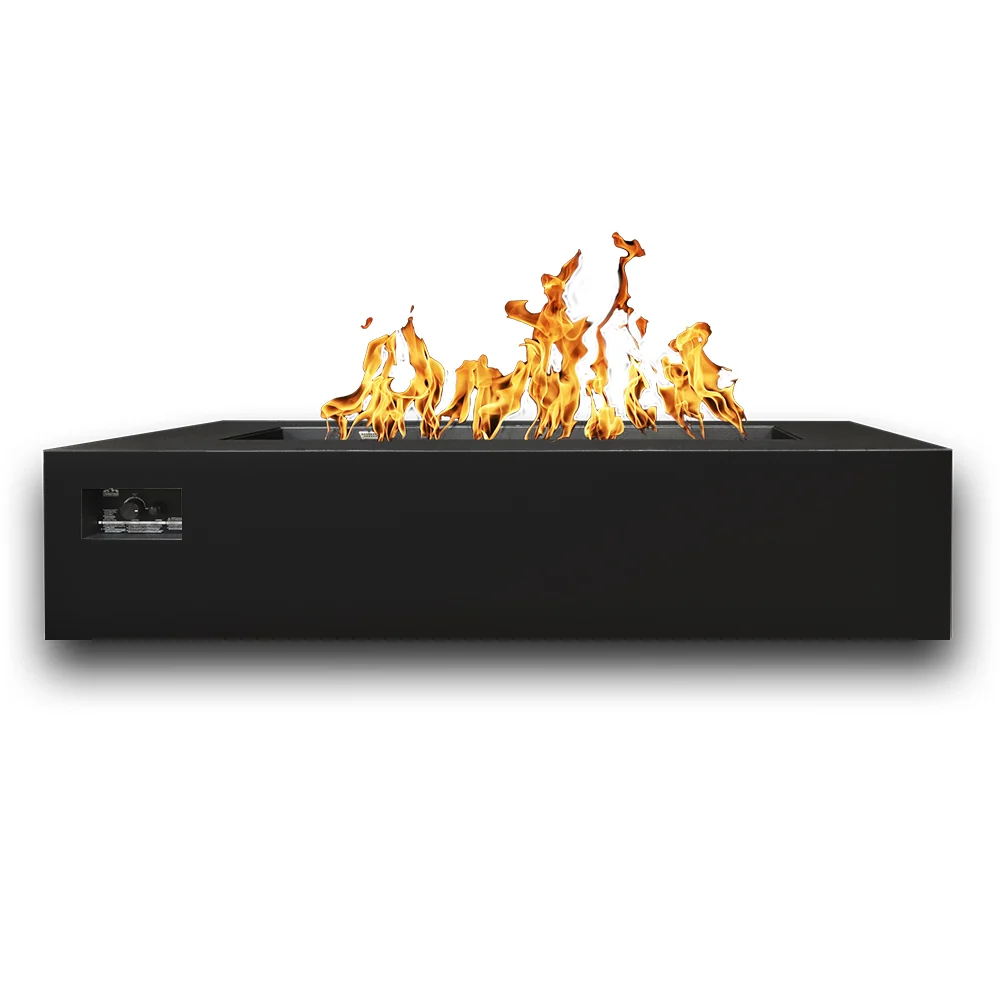
Best Fire Table for Weather and Water Management: Warming Trends AON R60
Best for: Hotels, restaurants, pool areas, exposed patios, and commercial properties where drainage and weather resilience are major planning concerns.
The Warming Trends AON 60-Inch Rectangle Gas Fire Table combines a rectangular table format with the Warming Trends Crossfire burner system. The product includes features intended to support water and debris management, making it a useful example for commercial projects where rain, irrigation, or pool splash could otherwise affect the gas and ignition system.
Available ignition choices allow the project team to select an operating strategy that fits the property. Electronic ignition can support staff controls, timers, and managed operation, but it also requires correct voltage, transformer placement, drainage, accessible components, and periodic inspection.
The included burner cover can protect the burner area when the fire feature is not in use, but it does not replace a complete maintenance and weather-protection plan.
Before ordering, confirm:
- Crossfire burner input
- Match-light, flame-sensing, or electronic ignition selection
- Required voltage
- WaterStop and drainage requirements
- Fuel type and pressure
- Commercial certification
- Timer and control compatibility
- Flush-cover use and storage
- Service access beneath or within the table
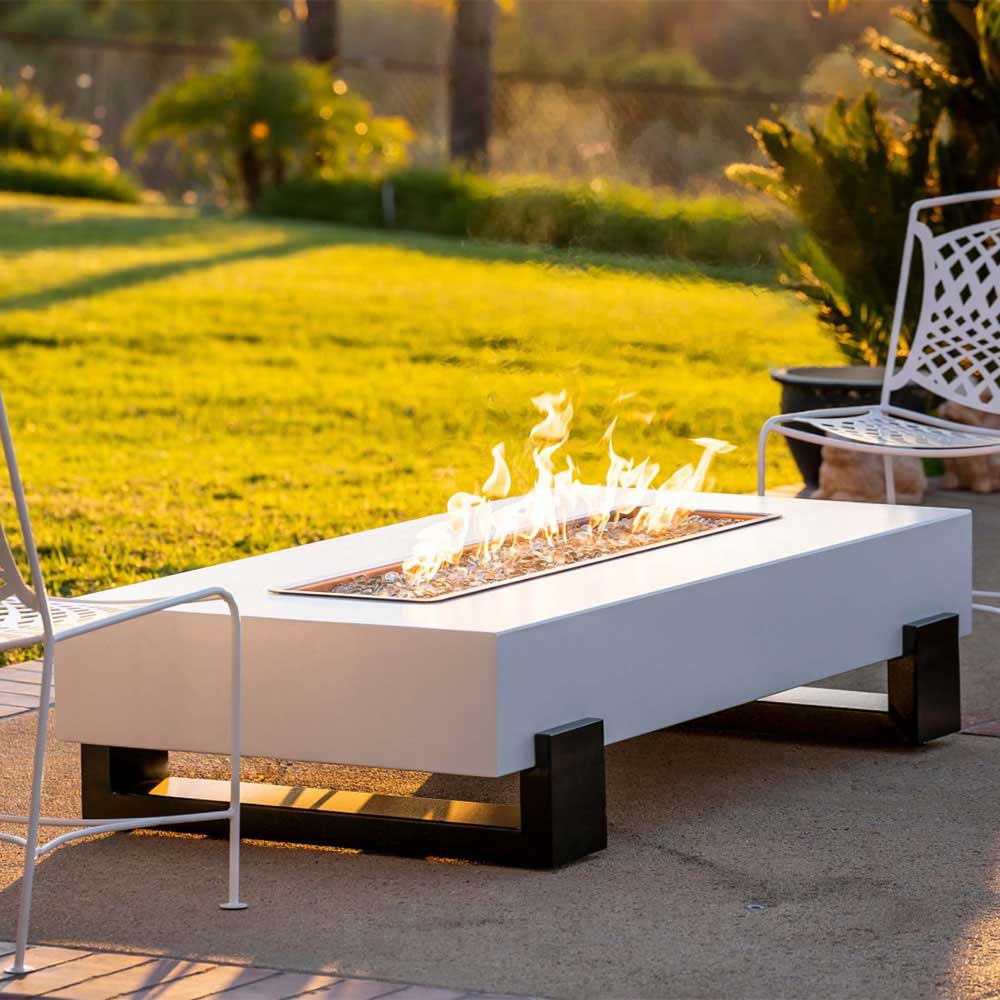
Best Unique Modern Linear Design: The Outdoor Plus Baja
Best for: Contemporary hotels, rooftop lounges, luxury apartments, restaurant patios, modern office campuses, and commercial landscapes where the fire feature is part of the architectural design.
The The Outdoor Plus Baja Linear Fire Pit stands apart from a traditional rectangular fire table through its unique black-and-white powder-coated steel design. The contrasting finishes and sculptural profile give it a graphic, modern appearance that can function as an architectural focal point even when the flame is turned off.
Rather than serving only as a table placed in the center of a furniture group, the Baja can be used to define an outdoor room, create a strong visual sightline, or run parallel to a long seating arrangement. This makes it especially effective in contemporary hospitality spaces where the fire feature must complement clean lines, contrasting materials, and intentional landscape geometry.
Multiple available lengths allow the designer to coordinate the fire feature with the furniture and architecture instead of forcing one standard size into every space. A shorter Baja can anchor an intimate lounge zone, while longer versions can align with sectional seating, built-in benches, rooftop edges, or restaurant conversation areas.
Available ignition options may include match-light, flame-sensing, and electronic configurations. The selected length and ignition option can affect the listed input, gas demand, power requirements, certification, controls, and service plan.
Before ordering, confirm:
- Selected overall length
- Furniture and architectural alignment
- Black-and-white finish coordination
- Fuel and listed input
- Exact ignition configuration
- Commercial certification
- Electrical and control requirements
- Gas-line and regulator capacity
- Wind exposure along the flame line
- Drainage, finish care, and service access
Commercial Fire Pit Installation and Service Planning
A complete fire pit can reduce enclosure fabrication, but it does not eliminate installation coordination. The appliance must remain serviceable throughout its life.
Review:
- Delivery path and lifting requirements
- Final placement and anchoring
- Combustible clearances
- Overhead structures
- Gas entry location
- Shutoff-valve access
- Regulator access
- Electrical service
- Transformer location
- Timer, wall switch, key switch, or emergency stop
- Ignition-module access
- Burner-pan removal
- Media removal
- Drainage
- Ventilation where required
- Protective-cover storage
- A clear replacement and removal path
Service-Access Warning: Do not bury the valve, transformer, ignition control, regulator, or gas connection behind permanent finishes. Commercial service becomes substantially more expensive when the enclosure or surrounding construction must be dismantled to reach the system.
Accessibility Planning
Hotels, condominiums, restaurants, public-facing businesses, and institutional properties may need to account for accessible routes and usable gathering areas.
Coordinate with the project architect, design team, and applicable authority regarding:
- Accessible approach routes
- Clear floor space
- Control reach when guests operate the feature
- Seating integration
- Walking-path width
- Furniture placement
- Emergency-control access
- Hot-surface boundaries
- Avoiding obstruction of required egress
Do not rely on one universal fire pit layout for every property. Accessibility obligations depend on the project and applicable requirements.
Commercial Fire Pit Maintenance
Commercial fire features should have a written inspection and cleaning plan before they are opened to guests.
Routine tasks may include:
- Removing debris from the burner and media
- Checking media depth and placement
- Inspecting burner ports
- Inspecting ignition electrodes and flame sensors
- Checking drains and weep openings
- Testing timers and emergency controls
- Inspecting gas connections and regulators
- Cleaning stainless-steel components
- Cleaning and inspecting glass guards
- Inspecting enclosure finishes
- Checking for corrosion, chips, coating damage, or staining
- Testing shutdown response
- Confirming covers are used correctly
- Completing seasonal startup and shutdown procedures
Common Commercial Fire Pit Specification Mistakes
Selecting by Appearance Alone
The burner, ignition, controls, gas supply, certification, drainage, and service plan are just as important as the enclosure design.
Assuming Every Ignition Option Is Commercially Certified
Certification may apply only to specific burner, fuel, input, and ignition configurations.
Undersizing the Gas Supply
Large burners and multiple fire features can create substantial simultaneous demand.
Treating BTUs as the Only Performance Measure
Wind, burner design, flame distribution, media, and seating distance affect real-world comfort and appearance.
Ignoring Automatic Shutoff Controls
Guests may leave the feature operating after they exit the area.
Placing Furniture Too Close
Movable chairs and tables may shift closer to the fire after the property opens.
Failing to Plan Drainage
Water can collect around the burner, controls, and ignition components.
Trapping Components Behind Permanent Finishes
Valves, regulators, transformers, controls, and ignition components must remain accessible.
Using Fire Media Without a Maintenance Plan
Media can be displaced, contaminated, covered with debris, or removed from unattended spaces.
Ignoring Wind Conditions
Rooftops and building corners can create unstable flame behavior and nuisance shutdowns.
Assuming Concrete or Stainless Steel Requires No Maintenance
Every commercial enclosure requires cleaning and inspection.
Forgetting Seasonal Procedures
Freeze-thaw climates may require shutdown, draining, covering, inspection, or specific restart procedures.
Failing to Train Property Staff
Managers and maintenance teams should know how to start, stop, inspect, clean, and isolate the feature.
Commercial Fire Pit Commissioning Checklist
- Verify the installed product and burner model.
- Confirm the selected fuel type.
- Confirm the exact listed input.
- Verify certification documentation.
- Confirm commercial warranty eligibility.
- Verify gas-line and regulator capacity.
- Leak test every connection.
- Confirm shutoff-valve access.
- Verify electrical voltage and transformer installation.
- Test the complete ignition sequence.
- Verify flame sensing.
- Test shutdown after flame loss where applicable.
- Test the countdown timer.
- Test the emergency stop.
- Confirm control labels.
- Inspect burner flame and distribution.
- Verify fire-media depth and placement.
- Inspect drainage.
- Verify enclosure ventilation where required.
- Confirm manufacturer clearances.
- Confirm the final furniture layout.
- Review wind conditions.
- Verify burner, control, valve, regulator, and transformer access.
- Record model and serial numbers.
- Photograph utilities and controls before final concealment.
- Provide manuals and warranty documents.
- Train property staff.
- Create a written cleaning and inspection schedule.
- Post operating and emergency instructions.
Commercial Fire Pit FAQs
What makes a fire pit suitable for commercial use?
A commercial fire pit should be evaluated for the exact ignition certification, property approval, warranty coverage, burner construction, controls, gas demand, drainage, service access, maintenance, and replacement-part availability.
Do commercial fire pits need electronic ignition?
Not every commercial project requires electronic ignition, but many hotels, restaurants, rooftops, resorts, and shared properties benefit from controlled startup, flame monitoring, timers, and automatic shutdown. Confirm the project requirements and exact certified configuration.
Can a match-lit fire pit be used commercially?
Possibly, but approval depends on the exact product, ignition system, property type, applicable requirements, and manufacturer documentation. Do not assume that every match-lit option is approved.
What is flame-sensing ignition?
A flame-sensing system is designed to stop gas flow if the flame is lost. The lighting and reset process varies by product and should be included in staff training.
How many BTUs should a commercial fire pit have?
There is no universal requirement. Compare the burner size, flame distribution, seating distance, wind, enclosure height, gas capacity, and desired visual effect.
Will a gas fire pit heat an entire restaurant patio?
Most open fire pits provide ambiance and localized radiant heat. A complete patio-heating plan may also require dedicated gas or electric heaters.
What size fire pit is best for a hotel or restaurant?
The correct size depends on the furniture layout, expected group size, guest circulation, available gas, desired flame presentation, and required clearances.
Is one large fire pit or several smaller fire pits better?
One large feature creates a prominent destination, while several smaller features can divide the patio into separate gathering zones and preserve partial availability during maintenance.
Are concrete fire pits good for commercial properties?
Concrete fire pits can provide a substantial architectural appearance and resist many outdoor conditions, but they still require finish care, drainage, cleaning, and protection from impact and standing water.
Can propane be used for a commercial fire pit?
Yes, when the product and project permit it. The property must plan tank capacity, regulator selection, refill procedures, security, vaporization, and applicable restrictions.
Do commercial fire pits need timers?
A timer can be valuable where guests may leave the feature operating. It should be coordinated with the ignition system and property operating plan.
Can a commercial fire pit use a wall switch?
Some electronic ignition systems can be operated by approved wall switches, key switches, timers, or automation controls. Use only compatible components and follow the manufacturer instructions.
Should a commercial fire pit have an emergency stop?
An emergency stop may be appropriate or required depending on the property, control strategy, and applicable requirements. Place it where staff can identify and access it quickly.
How should a commercial fire pit gas line be sized?
Size the system using total connected input, simultaneous demand, fuel type, pressure, run length, pipe diameter, fittings, meter or tank capacity, and regulator requirements.
Do commercial fire pits need glass guards?
Not every fire pit requires one, but a guard may help establish a boundary, protect the burner area, and reduce direct wind. It does not eliminate clearance or supervision requirements.
How far should seating be from a commercial fire pit?
Follow the manufacturer instructions and coordinate the actual furniture, surface temperatures, guest movement, and applicable requirements. Avoid publishing one universal distance for every product.
How do wind and rain affect electronic ignition?
Wind can affect ignition and flame stability, while water can cause corrosion, delayed ignition, or nuisance shutdowns. Correct drainage, placement, controls, and maintenance are essential.
What fire pit components need service access?
Maintain access to the burner, pan, ignition module, electrodes, flame sensor, valve, gas connection, regulator, transformer, timer, emergency control, and drainage points.
Can a fire pit be installed on a rooftop?
Rooftop projects require careful coordination of fuel, wind, structure, drainage, clearances, controls, accessibility, and applicable requirements. Verify that the exact product is approved for the proposed installation.
How often should a commercial fire pit be inspected?
Inspection frequency depends on use, exposure, manufacturer instructions, and the property maintenance plan. High-use or exposed features should be checked routinely rather than only after a problem appears.
What fire pit shape works best for group seating?
Round features support seating on all sides, while rectangular and linear features pair well with sofas, benches, and long conversation areas. Select the shape around the actual furniture plan.
Why is drainage important for a gas fire pit?
Drainage helps prevent water from collecting around the burner, controls, and ignition components. Standing water can contribute to corrosion, unreliable ignition, and service problems.
Can a commercial fire pit be automated?
Some electronic ignition systems can be integrated with approved timers, switches, remotes, or building controls. The complete control strategy must be compatible with the ignition system and project requirements.
Choose the Fire Pit for the Entire Commercial Project
The best commercial fire pit is not automatically the largest, most powerful, or most visually dramatic model. It is the feature that matches the property’s furniture plan, guest circulation, fuel supply, controls, ignition certification, weather exposure, maintenance capabilities, and long-term operating strategy.
Verify the exact configuration before ordering, size the gas system for simultaneous demand, preserve service access, plan drainage, and provide property staff with clear operating and maintenance procedures.
SpotixPro helps contractors, developers, designers, landscape professionals, and property managers compare fire pits, burner systems, ignition controls, gas components, and accessories for residential and commercial projects.
Need Help Selecting a Commercial Fire Pit?
Ready to Compare Fire Features?