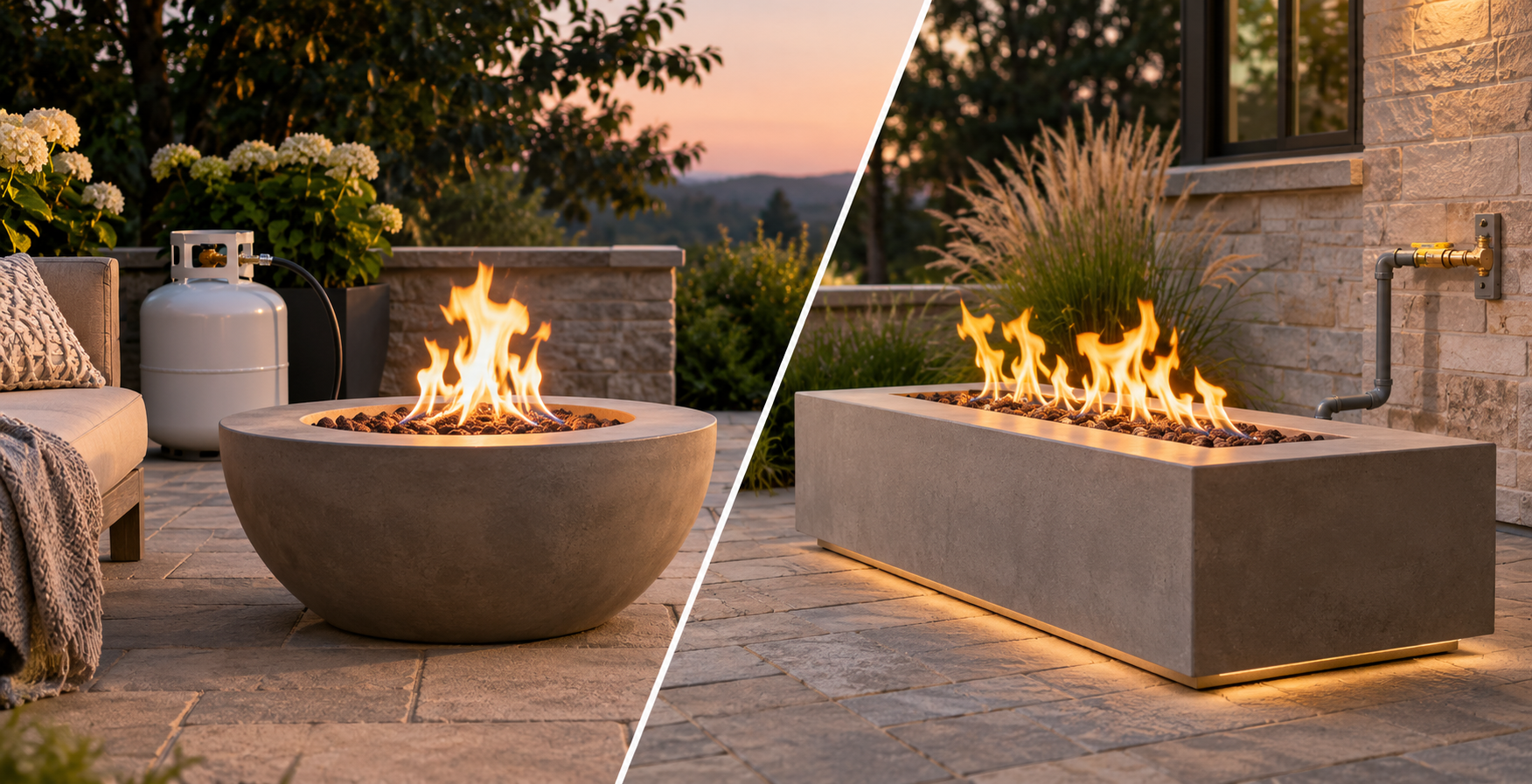
Choosing a gas fire pit involves more than finding the right size, shape, or finish. One of the most important decisions happens before installation: choosing between propane and natural gas.
When comparing a propane vs natural gas fire pit, the right choice depends on your outdoor space, how often you plan to use your fire pit, your budget, and whether you have access to an existing gas line.
Both fuels can create an inviting outdoor gathering space, but they come with different installation requirements, operating costs, and placement considerations. Understanding those differences early can help you avoid unexpected expenses and choose a fire pit that works for your project.
Propane vs Natural Gas Fire Pit: Quick Comparison
Not sure which fuel is right for your outdoor space? Here's how propane and natural gas compare across the factors that matter most.
| Feature | Propane | Natural Gas |
|---|---|---|
| Upfront Cost | Often lower with a portable tank setup | May be higher if a new gas line is required |
| Running Cost | Often higher per unit of heat | Often lower where utility service is available |
| Installation | Generally simpler with an approved tank connection | Requires a properly sized gas connection |
| Heat Output | Depends on burner rating and fuel supply | Depends on burner rating and gas pressure |
| Run Time | Limited by tank capacity | Continuous while gas service is available |
| Portability | More placement flexibility with compatible models | Generally fixed to the gas line location |
| Best For | Flexible layouts, no gas line, occasional use | Permanent installations and frequent use |
Neither fuel is automatically better. The goal is to match your fuel supply to how you plan to use your outdoor space.
.jpg)
When Does a Propane Gas Fire Pit Make Sense?
A propane gas fire pit is often the most practical choice when you want to add an outdoor fire feature without extending a natural gas line.
You Don't Have an Existing Gas Line
If your patio or backyard doesn't have natural gas service nearby, propane can simplify the project.
Many outdoor propane fire pit models connect to a compatible propane tank using manufacturer-specified components. This can eliminate the need for permanent gas piping, although installation and safety requirements still apply.
You Want More Flexibility With Placement
Propane provides more flexibility when choosing where your fire pit will go. You're not necessarily limited by an existing gas connection, making it useful for patios, poolside gathering areas, and landscape designs where extending a gas line would be impractical.
However, not every propane model is portable. Larger concrete or steel fire pits may be intended for permanent placement even when connected to a propane tank.
You Want a Simpler Installation
A compatible propane setup may require less site preparation than installing a new natural gas line. However, you'll still need to confirm the correct regulator, hose, fittings, fuel supply, and ignition configuration.
PRO Tip: Before specifying propane for a project, determine where the tank will be located and how the fuel connection will be routed. These details can affect the finished design and future maintenance access.
.jpg)
When Does a Natural Gas Fire Pit Make Sense?
A natural gas fire pit is worth considering when you're planning a permanent outdoor living space, especially if natural gas service is already available.
You Already Have Natural Gas Service
If your home has natural gas, extending service to an outdoor fire feature may be possible. A licensed gas professional should evaluate the available supply, distance to the fire pit, and requirements of the selected burner.
An existing gas line doesn't automatically mean it can support another appliance. The total demand from connected appliances and the piping system's capacity must be considered.
For a closer look at the planning process, read our Gas Line Sizing for Fire Pits, Fireplaces, and Outdoor Kitchens guide.
You Plan to Use Your Fire Pit Frequently
One of the biggest advantages of natural gas is convenience. Instead of monitoring a propane tank and arranging refills, your fire pit connects to a continuous fuel supply.
Natural gas can also offer lower ongoing fuel costs, although actual savings depend on local utility rates, propane prices, and usage.
You're Building a Permanent Outdoor Space
Natural gas is often a strong fit for custom patios, outdoor kitchens, and professionally designed landscapes. Since the fire pit connects to fixed piping, the fuel supply can be incorporated into the project during construction.
PRO Tip: Coordinate gas supply requirements before hardscaping or decking is completed. Confirm the selected appliance's fuel demand, required pressure, and installation instructions with the gas professional.
.jpg)
Where Does the Propane Tank Go?
One of the most common questions homeowners ask about fire pit propane setups is where the tank will actually sit.
The answer depends on the fire pit design, tank size, and manufacturer's installation requirements.
Using a Standard 20 lb Propane Tank
A standard 20 lb propane tank is a familiar option for many outdoor gas appliances. Some gas fire pits accommodate this tank inside a specially designed compartment, while others require an external tank.
Before purchasing, confirm whether your chosen model supports internal tank storage, an external connection, or a different fuel supply arrangement.
What About Larger Propane Tanks?
For larger installations or fire features with greater fuel demand, a larger propane tank may be worth considering.
Larger tanks can reduce refill frequency, but they also introduce additional placement, connection, and installation considerations. A qualified propane supplier can help determine the appropriate setup.
How Far Should the Tank Be From the Fire Pit?
There isn't one universal distance that applies to every propane gas fire pit. Tank placement depends on the appliance's listing, manufacturer instructions, tank configuration, and applicable local requirements.
Important: Never assume a propane tank can be stored directly underneath or beside a fire pit unless the manufacturer specifically approves that arrangement. Follow the required clearances and use only approved connections.
How Can You Hide a Propane Tank?
If you prefer a clean, finished appearance, consider these options:
- Integrated tank storage: Some fire pits include a manufacturer-approved compartment for a compatible tank.
- Separate tank enclosures: Purpose-built enclosures can conceal external tanks while maintaining required ventilation and access.
- Decorative covers: A propane tank cover can help coordinate the fuel supply with your outdoor furniture and fire feature.
Any enclosure or cover must be approved for the intended use and must not obstruct ventilation, valves, or safe operation.
For a contemporary outdoor design, explore our concrete gas fire pits and compare available fuel configurations.

Can You Switch From Propane to Natural Gas Later?
Sometimes, but not always.
Certain manufacturers offer approved conversion kits for specific gas fire pit models. However, propane and natural gas systems aren't interchangeable simply because both use gas.
The fuels have different supply pressures and combustion requirements. Depending on the appliance, conversion may involve changes to components such as the burner orifice, regulator, or other fuel-specific parts.
Never connect a fire pit to a different fuel source without confirming that the manufacturer explicitly permits conversion.
Even when conversion is possible, it may require professional installation and additional expenses.
If you expect to add natural gas service later, consider that possibility before purchasing. Selecting the correct configuration upfront is generally simpler than modifying an existing installation.

Other Installation Decisions That Matter
Fuel type is only one part of selecting the right gas fire pit. Ignition, placement, and installation requirements can also influence which configuration you should purchase.
Match-Lit vs. Electronic Ignition
A match-lit system typically uses a manual gas valve and an approved lighting method. These systems have fewer electrical components but require hands-on operation.
Electronic ignition systems use electrical components to ignite the burner and may provide remote operation or flame-sensing safety features, depending on the model.
Some electronic ignition systems require a dedicated electrical supply, while others use batteries or alternative power arrangements.
Compare available options in our match-light gas fire pit kits and gas fire pit kits collections.
Can a Gas Fire Pit Sit on a Deck?
Possibly, but the answer depends on the specific model and deck construction.
Not every gas fire pit is approved for installation on combustible surfaces, including wood and composite decking. Review the manufacturer's requirements for surface materials, clearances, ventilation, and overhead structures.
Don't assume that placing a fire pit on a decorative pad automatically makes an otherwise prohibited installation acceptable.
Will You Need an Electrician or Additional Parts?
Natural gas installations generally require professional gas piping work. Electronic ignition systems may also require an electrician, depending on their power requirements and local regulations.
Other components, including connection kits, regulators, shutoff valves, or approved accessories, may be necessary depending on the model and installation.
For a custom project, explore our ready-to-finish gas fire pits or consider a compatible natural gas fire pit kit designed for your selected burner and fuel supply.

Featured Gas Fire Pits: Find the Right Style and Fuel Configuration
Once you've identified your preferred fuel, you can narrow your search by material, shape, size, and installation style.
These featured models from Dekko and The Outdoor Plus offer a starting point for comparing designs. Always select the appropriate fuel and ignition options on the individual product page.
.jpg)
Dekko: Contemporary Concrete Fire Pits
Dekko's concrete designs offer a modern look for patios, lounge areas, and outdoor gathering spaces.
- Avera: A rectangular concrete design with a clean, architectural profile. The 48-inch Avera offers propane and natural gas configurations, along with match-lit and electronic ignition options. A 60-inch Avera is also available.
- Sonoma: A longer rectangular design suited to linear seating arrangements. Explore the 56-inch Sonoma or 72-inch Sonoma and select the appropriate fuel configuration.
- Serenade: A rounded concrete fire bowl that works well as a central gathering feature. Compare the 32-inch Serenade and 40-inch Serenade for your outdoor layout.

The Outdoor Plus: Versatile Outdoor Fire Features
The Outdoor Plus offers concrete and powder-coated steel designs for residential patios and professionally planned outdoor spaces.
- Florence: The 42-inch Low Profile Florence provides a contemporary concrete option with propane and natural gas selections. Other designs include the 32-inch Mini Florence and 46-inch Round Florence.
- Coronado: A linear powder-coated steel design that complements larger seating areas and modern landscapes. The 60x28-inch Coronado offers propane and natural gas selections. For a custom finish, explore the ready-to-finish Coronado kit.
- Unity: The Unity 48x24-inch Round Gas Fire Pit is particularly appealing for propane installations because its design accommodates a standard 20 lb propane tank inside the unit. It also offers a natural gas configuration, giving homeowners options for different project requirements.
Shopping Tip: Fuel type and ignition selections can change installation requirements, compatible accessories, and overall project costs. Review the complete product configuration before ordering.
Frequently Asked Questions
Can I Convert a Propane Gas Fire Pit to Natural Gas?
Only if the manufacturer explicitly approves conversion for your specific model and provides the required components and instructions. Some models cannot be converted.
How Long Does a 20 lb Propane Tank Last?
Run time depends on the fire pit's fuel consumption, burner rating, flame setting, and usable tank capacity. Check the manufacturer's specifications to estimate how long your particular setup will operate.
Do I Need a Permit or Licensed Installer for Natural Gas?
Requirements vary by location. Contact your local building authority and a licensed gas professional to determine the permits, inspections, and installation qualifications required for your project.
Is Propane or Natural Gas Hotter?
Propane contains more energy per unit of volume, but that doesn't automatically make a propane gas fire pit hotter. Actual heat output depends on the fire pit's rated BTUs, burner design, and fuel supply. Compare individual product specifications rather than fuel type alone.

Find the Right Gas Fire Pit for Your Project
The best fuel choice comes down to how your outdoor space is designed and how you plan to use it.
Choose propane when flexible placement and avoiding a new gas line are priorities. Consider natural gas when you're planning a permanent installation and want the convenience of a continuous fuel supply.
Ready to compare your options? Explore our propane fire pit collection or browse our gas fire pits to compare available natural gas configurations.
Planning a larger outdoor project? Contact Spotix to connect with our team. Contractors, designers, landscapers, and other trade professionals can also ask about SpotixPRO for specialized product guidance and project support.