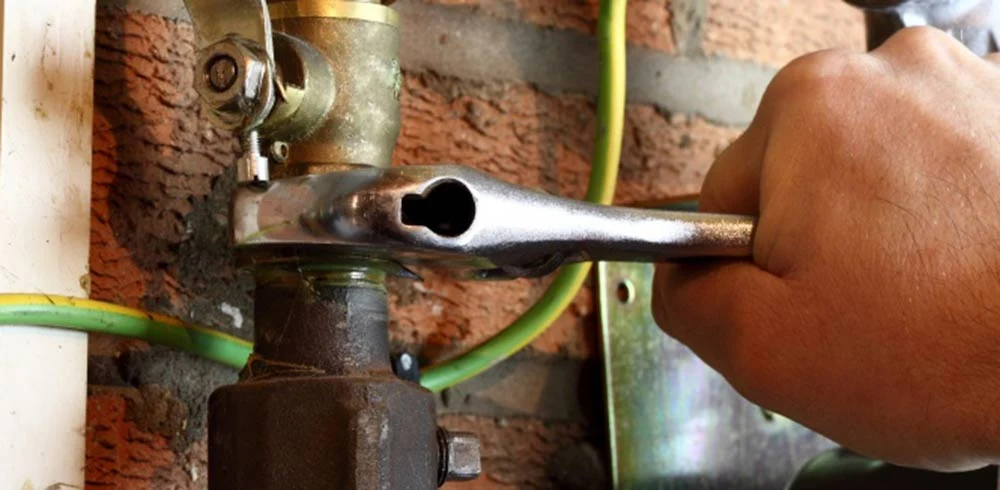
Incorrectly sized pipe threads can turn a straightforward gas fire feature installation into an unexpected return trip. A fitting that appears to be 1/2-inch may measure closer to 0.84 inches across the outside, while two components labeled with similar connection sizes may use incompatible thread standards.
For contractors, confirming pipe thread size before ordering or arriving at the jobsite can help prevent installation delays, product returns, damaged components, and connection problems. This guide explains how to identify common U.S. pipe threads, verify component compatibility, and avoid common fitting mistakes when working with gas fire pits, fireplaces, outdoor kitchens, and other gas appliances.
SpotixPro Quick Answer: Verify the outside diameter of male fittings or the inside/top diameter of female fittings, then compare that measurement with a nominal pipe size chart. Do not assume that the measured diameter will match the listed pipe thread size.
Why Pipe Thread Sizing Matters on Professional Installations
A mismatched fitting may seem like a small ordering issue, but it can affect the entire installation schedule. Contractors may encounter connection problems between burners, regulators, flex lines, valves, manifolds, and incoming gas lines when component specifications are not verified in advance.
Incorrect pipe thread selection can contribute to:
- Unexpected jobsite delays
- Additional product orders or returns
- Fittings that will not thread together properly
- Damaged or cross-threaded connections
- Improperly sealed gas connections
- Failed inspections or required rework
- Reduced confidence from the homeowner or project manager
A few measurements taken during project planning can help prevent these issues before installation begins.
Where Contractors Encounter Pipe Thread Connections
Pipe threads are used throughout residential and commercial gas fire feature installations. Contractors should verify connection sizes anywhere two fuel-delivery components meet.
Common connection points include:
- Gas fire pit burners
- Burner pans and burner assemblies
- Gas flex lines
- Pressure regulators
- Manual shutoff valves
- Key valves and control valves
- Gas manifolds
- Whistle-free hoses
- Natural gas and propane supply connections
- Fireplace and outdoor kitchen appliance inlets
Do not rely only on the general product category or the size of the appliance. Confirm the listed inlet, outlet, and fitting specifications for each individual component.
Understanding NPT Pipe Threads
NPT refers to National Pipe Taper threads, commonly called National Pipe Threads. NPT is one of the most common pipe thread standards used for gas and fluid connections in the United States.
NPT fittings use tapered threads. As the male and female fittings are tightened together, the taper creates increasing contact between the threads. An approved thread sealant or gas-rated pipe thread tape may also be required to create a proper seal, depending on the fitting and manufacturer instructions.
NPT fittings are identified using nominal pipe size rather than the actual outside measurement of the fitting. This is why a 1/2-inch NPT fitting does not measure exactly 1/2-inch across its outside diameter.
Four Specifications to Verify Before Ordering Fittings
Before selecting replacement fittings or connecting gas components, confirm the following four specifications.
| Specification | What to Check | Why It Matters |
|---|---|---|
| Nominal pipe size | The standard size used to identify the pipe or fitting | The nominal size may differ from the fitting's actual measured diameter. |
| Male or female connection | Whether the fitting has external or internal threads | Two male or two female connections require an additional fitting or adapter. |
| Thread standard and pitch | NPT, BSPT, or another standard, plus the threads-per-inch count | Similar-looking thread standards may not be compatible. |
| Pipe schedule | The wall thickness of the pipe | Schedule affects wall thickness and internal diameter even when nominal size remains the same. |
How to Measure Male and Female Pipe Threads
Use a caliper, fitting gauge, or accurate measuring tool whenever possible. A ruler or tape measure may be sufficient for an initial estimate, but smaller differences can be difficult to identify accurately without a more precise tool.
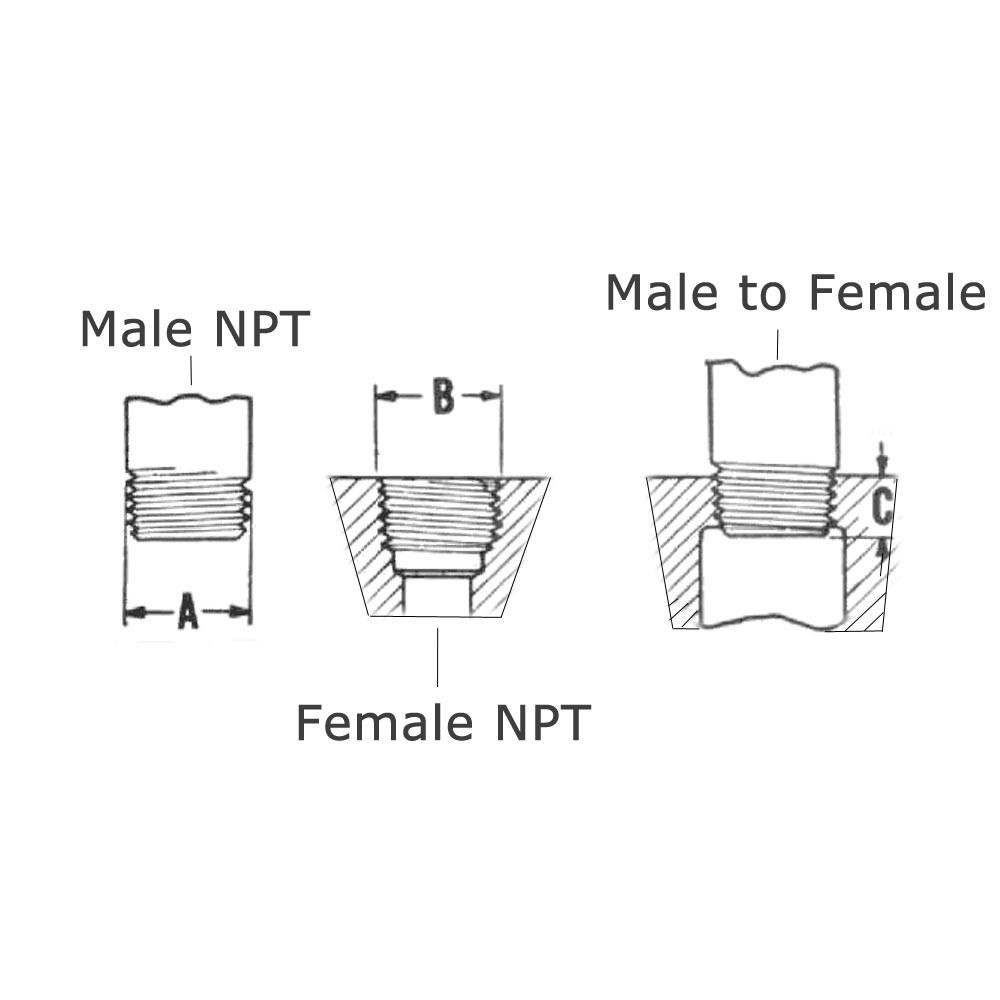
For a male fitting: Measure across the widest outside portion of the threaded section. This measurement is the outside diameter, or OD.
For a female fitting: Measure across the inside/top opening of the threaded connection.
Compare the measurement with a nominal pipe size chart. The measured diameter identifies the physical size of the fitting, while the nominal pipe size is the standardized name used when ordering the component.
Quick Pipe Thread Measurement Guide
| What to Verify | How to Check It | What It Confirms |
|---|---|---|
| Male fitting diameter | Measure across the outside of the threaded section | The actual OD to compare with nominal pipe size |
| Female fitting diameter | Measure across the inside/top opening | The likely nominal size of the matching male fitting |
| Threads per inch | Count the threads along a one-inch section or use a thread gauge | The thread pitch and potential thread standard |
| Male or female orientation | Identify whether threads are external or internal | Whether an adapter, nipple, coupling, or union is needed |
U.S. NPT Pipe Thread Size Reference Chart
The following chart compares common outside diameters with their corresponding nominal pipe sizes and threads per inch. Measurements should be treated as reference values. Always confirm the manufacturer specifications for the components being installed.
| Approximate OD Fraction | Approximate OD Decimal | Nominal Pipe Size | Threads Per Inch |
|---|---|---|---|
| 5/16 in. | 0.3125 in. | 1/16 in. | 27 |
| 13/32 in. | 0.405 in. | 1/8 in. | 27 |
| 35/64 in. | 0.540 in. | 1/4 in. | 18 |
| 43/64 in. | 0.675 in. | 3/8 in. | 18 |
| 27/32 in. | 0.840 in. | 1/2 in. | 14 |
| 1-3/64 in. | 1.050 in. | 3/4 in. | 14 |
| 1-5/16 in. | 1.315 in. | 1 in. | 11-1/2 |
| 1-21/32 in. | 1.660 in. | 1-1/4 in. | 11-1/2 |
| 1-29/32 in. | 1.900 in. | 1-1/2 in. | 11-1/2 |
| 2-3/8 in. | 2.375 in. | 2 in. | 11-1/2 |
| 2-7/8 in. | 2.875 in. | 2-1/2 in. | 8 |
| 3-1/2 in. | 3.500 in. | 3 in. | 8 |
| 4 in. | 4.000 in. | 3-1/2 in. | 8 |
| 4-1/2 in. | 4.500 in. | 4 in. | 8 |
What Pipe Schedule Means for Contractors
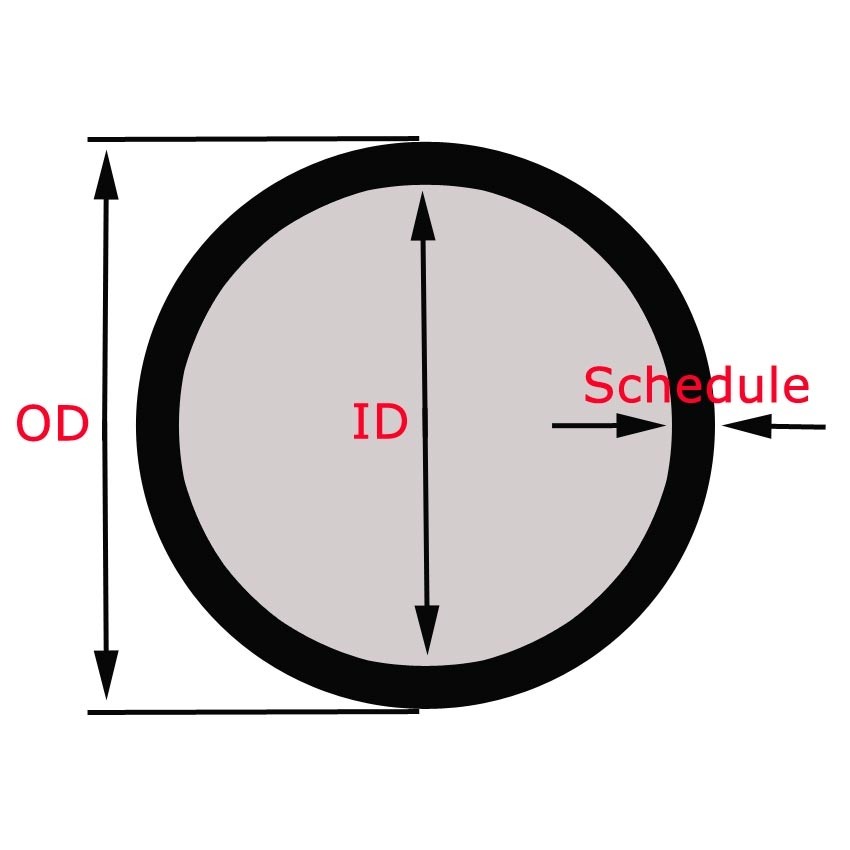
Pipe schedule refers to wall thickness. Two pipes may have the same nominal pipe size and outside diameter but different wall thicknesses and internal diameters.
This distinction matters because pipe schedule can affect internal flow area, pressure considerations, material strength, and project specifications. Schedule does not automatically change the external NPT thread designation, but it should still be verified as part of the complete gas system design.
Pipe sizing, schedule, gas pressure, run length, and BTU demand should be evaluated together. A matching threaded connection does not necessarily mean the complete gas supply system is sized correctly for the appliance.
How Thread Pitch Helps Confirm a Fitting
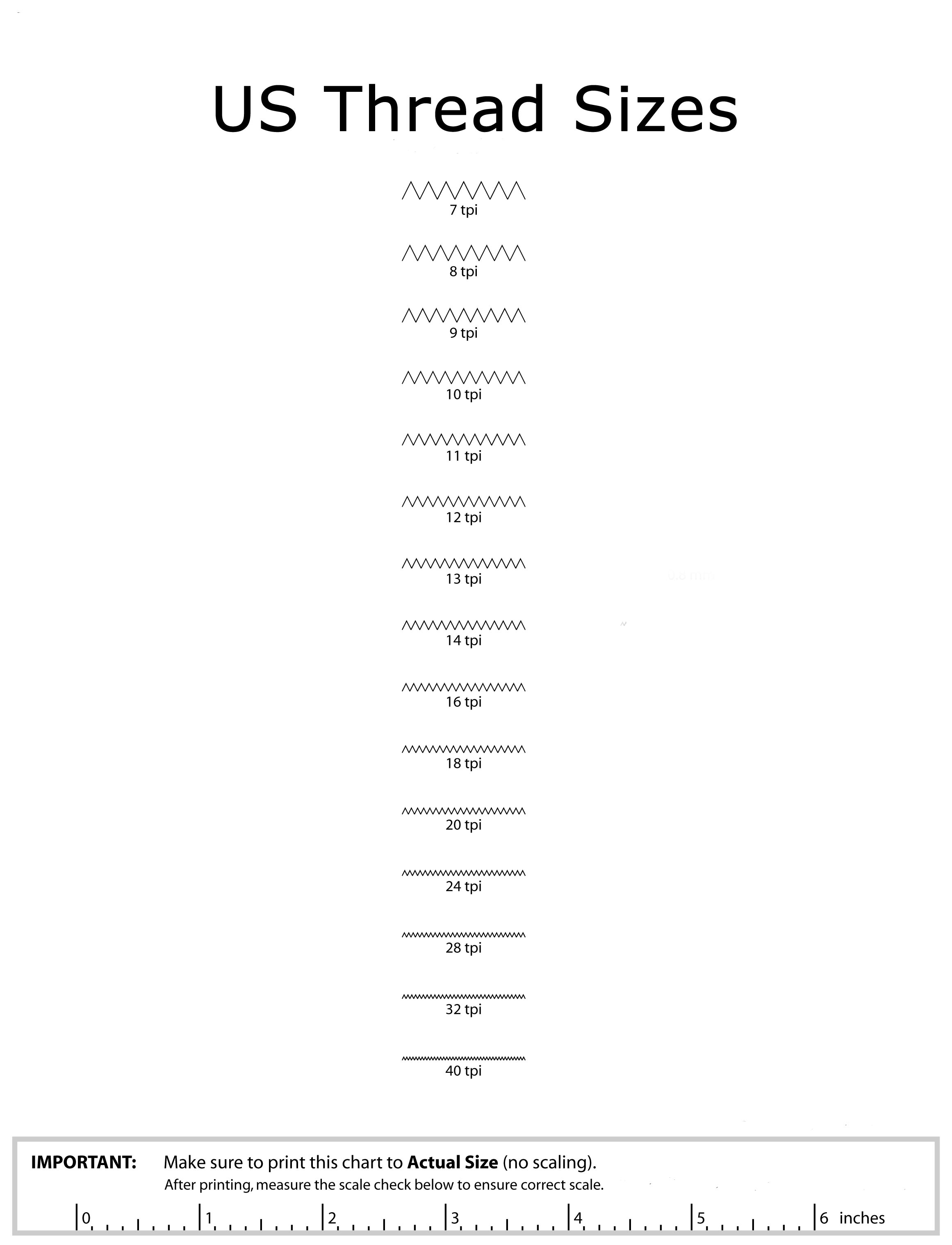
Threads per inch, or TPI, describes how many thread peaks occur within one inch of the threaded section. This measurement is also referred to as thread pitch.
Thread pitch can help contractors distinguish between fittings that have similar diameters but use different thread patterns. A thread gauge provides the most accurate field identification. A printed thread chart may also be useful when printed at its intended scale.
NPT threads use a 60-degree thread angle with a taper of approximately 1 in 16. BSPT threads use a different thread angle and may use different pitch values, which is one reason the two standards should not be treated as interchangeable.
Common Fitting Mismatches to Check Before Ordering
Many fitting problems are caused by compatibility assumptions rather than incorrect measurements alone. Before placing an order, confirm every connection on the planned component chain.
- Male-to-male connections: Two components with external threads require a female coupling or another compatible transition fitting.
- Female-to-female connections: Two internally threaded components may require a nipple with male threads on both ends.
- Different nominal sizes: A reducer or reducing adapter may be needed when component inlet and outlet sizes differ.
- NPT-to-BSPT connections: These standards use different thread geometry and should not be forced together.
- Pipe thread-to-flare connections: Flare fittings seal differently than NPT fittings and require the correct adapter.
- Natural gas-to-propane components: Matching threads do not confirm that a component is approved for the project's fuel type or pressure.
- Regulator orientation errors: Inlet and outlet connections may use different sizes or fitting types.
Future Spotix Data Update: This section will be expanded after order and return data is reviewed to identify the most frequently misordered or mismatched fitting. The final update should include the affected fitting, the commonly confused alternative, the reason for the mismatch, and a practical verification step contractors can use before ordering.
Common Pipe Thread Sizing Mistakes on the Jobsite
Assuming the Listed Size Equals the Measured Diameter
Nominal pipe size is a standardized trade designation. A 1/2-inch NPT male fitting has an outside diameter of approximately 0.84 inches, not 0.50 inches. Ordering based only on the physical measurement can lead to the wrong fitting size.
Forcing Similar-Looking Threads Together
If a fitting begins threading but quickly binds, stop. Forcing mismatched threads can damage both components and may create an unsafe connection. Verify the diameter, thread pitch, and standard before continuing.
Confusing NPT With Flare Connections
NPT fittings seal along tapered threads, while flare fittings seal where the flared surfaces meet. Thread sealant should not be applied to the sealing surface of a flare fitting unless specifically directed by the manufacturer.
Overtightening a Tapered Fitting
More force does not always produce a better seal. Overtightening can crack valves, regulators, burner inlets, or softer metal components. Follow manufacturer torque and installation guidance.
Using the Wrong Thread Sealant
Use only thread sealants or tapes approved for the project fuel type and application. Some products may be appropriate for natural gas but not propane, high-pressure systems, or certain fitting materials.
Reusing Damaged Fittings
Inspect fittings for flattened threads, corrosion, cracking, contamination, or previous cross-threading. Replacing a questionable fitting is generally preferable to risking a leaking or unreliable connection.
Pipe Thread Terms Contractors Should Know
| Term | Contractor Definition |
|---|---|
| NPT | National Pipe Taper thread, a tapered pipe thread standard commonly used for gas and fluid connections in the United States. |
| NPS | Nominal pipe size, the standardized trade size used to identify pipe and fitting dimensions. It does not always equal the measured outside diameter. |
| BSPT | British Standard Pipe Taper thread, a pipe thread standard commonly used outside the United States. Its thread angle and pitch differ from NPT. |
| MIP or MPT | Male iron pipe or male pipe thread, indicating external pipe threads. In many U.S. gas applications, these are NPT threads. |
| FIP or FPT | Female iron pipe or female pipe thread, indicating internal pipe threads that accept a compatible male connection. |
| OD | Outside diameter, measured across the exterior of a pipe or male fitting. |
| ID | Inside diameter, representing the open internal dimension of a pipe. |
| TPI | Threads per inch, used to describe thread pitch and help identify a thread standard. |
| Adapter | A fitting that connects different pipe sizes, thread types, connection styles, or materials. |
| Coupling | A fitting with female threads on both ends that joins two compatible male-threaded components. |
| Nipple | A short pipe section with male threads on both ends that connects two compatible female-threaded components. |
| Union | A fitting that allows connected piping or equipment to be disconnected without rotating the adjoining pipe sections. |
SpotixPro Pre-Installation Connection Checklist
Use this checklist before ordering components and again before beginning the installation.
- Confirm whether the project uses natural gas or propane.
- Verify the required gas pressure for each appliance or burner system.
- Confirm the total BTU demand of the installation.
- Verify the incoming gas line size and available capacity.
- Check the inlet and outlet sizes of each component.
- Identify every male and female connection in the planned assembly.
- Confirm that all threaded connections use compatible standards.
- Identify any reducers, adapters, nipples, couplings, or unions required.
- Verify the correct regulator type and orientation.
- Use manufacturer-approved flex lines and connection components.
- Confirm that fittings and sealants are approved for the fuel type.
- Inspect all threads for damage before assembly.
- Follow manufacturer instructions and applicable local codes.
- Perform all required pressure and leak testing before operation.
Best Practices for Assembling NPT Gas Connections
Correct sizing is only one part of creating a reliable gas connection. Contractors should also follow proper preparation, assembly, and testing procedures.
- Clean the threads: Remove dirt, old sealant, metal fragments, and other contamination before assembly.
- Start fittings by hand: A properly matched fitting should begin threading without excessive resistance.
- Use approved sealant: Apply gas-rated thread sealant according to the product and equipment manufacturer instructions.
- Avoid contaminating the gas path: Keep excess sealant away from the first threads and internal openings.
- Support connected components: Do not allow piping weight or movement to place unnecessary stress on valves, regulators, or appliance inlets.
- Do not use fitting tightness to correct alignment: Use the proper fittings and layout rather than overtightening a connection to force the desired position.
- Leak test every connection: Complete all required testing before placing the appliance or fire feature into service.
When a Matching Thread Size Is Not Enough
Two components may thread together correctly and still be unsuitable for the same installation. Thread size does not confirm fuel compatibility, pressure rating, flow capacity, temperature rating, material compatibility, or code approval.
Contractors should verify:
- Natural gas or propane compatibility
- Maximum inlet and outlet pressure
- Required regulator type
- BTU and flow capacity
- Indoor or outdoor approval
- Material and corrosion resistance
- Manufacturer installation requirements
- Local code and inspection requirements
For larger or more complex projects, pipe sizing calculations should be completed based on total BTU demand, gas pressure, piping material, and run length. Thread compatibility should be treated as one part of the complete fuel-system design.
Pipe Thread Sizing FAQs for Contractors
Why does a 1/2-inch pipe fitting measure larger than 1/2-inch?
The 1/2-inch designation is the nominal pipe size, not the actual outside diameter. A 1/2-inch NPT male fitting typically measures approximately 0.84 inches across the outside threads.
How do I identify an unknown male pipe fitting?
Measure the outside diameter of the threaded section, count or gauge the threads per inch, and compare both measurements with an NPT sizing chart. Also confirm whether the fitting could use another standard, such as BSPT or a flare connection.
Can NPT and BSPT fittings be connected?
NPT and BSPT use different thread geometry and should not be treated as directly interchangeable. Use a properly approved adapter when a transition between standards is required.
What is the difference between MIP and FIP?
MIP or MPT describes an external male pipe thread. FIP or FPT describes an internal female pipe thread. A compatible male fitting threads into a corresponding female fitting.
Does pipe schedule change NPT thread size?
Pipe schedule changes wall thickness and internal diameter. Pipes with the same nominal size generally maintain the same outside diameter, but contractors should verify the complete pipe specification and system requirements.
Should thread tape be used on every gas fitting?
No. Thread tape or sealant is generally used on compatible tapered pipe threads when approved by the manufacturer. It should not automatically be applied to flare sealing surfaces, compression fittings, or other connections that seal using a different method.
What should I do if a fitting only threads one or two turns?
Stop and verify the connection. The fittings may use different thread sizes, different pitch values, or incompatible standards. Continuing to tighten the connection may damage the threads.
Can an old fitting be reused?
Reuse depends on the fitting condition, application, manufacturer guidance, and local requirements. Replace fittings with damaged threads, corrosion, cracks, deformation, or signs of cross-threading.
Plan Gas Connections Before Arriving at the Jobsite
Professional fire feature installations depend on more than selecting the correct burner or appliance. Every regulator, valve, flex line, adapter, and threaded connection must work together as part of the complete fuel-delivery system.
Before ordering, document each connection in sequence and verify the nominal size, male or female orientation, thread standard, fuel type, pressure rating, and flow requirements. This process can help reduce fitting mismatches, avoid unnecessary return trips, and keep the project moving according to schedule.
Always follow manufacturer instructions, applicable codes, and required testing procedures. Gas connections should be installed and inspected by qualified professionals as required by local regulations.
Need Help Confirming Component Compatibility?
SpotixPro product specialists can help review burner, regulator, valve, flex line, and fitting specifications before you place your order.
Looking for Gas Installation Components?